
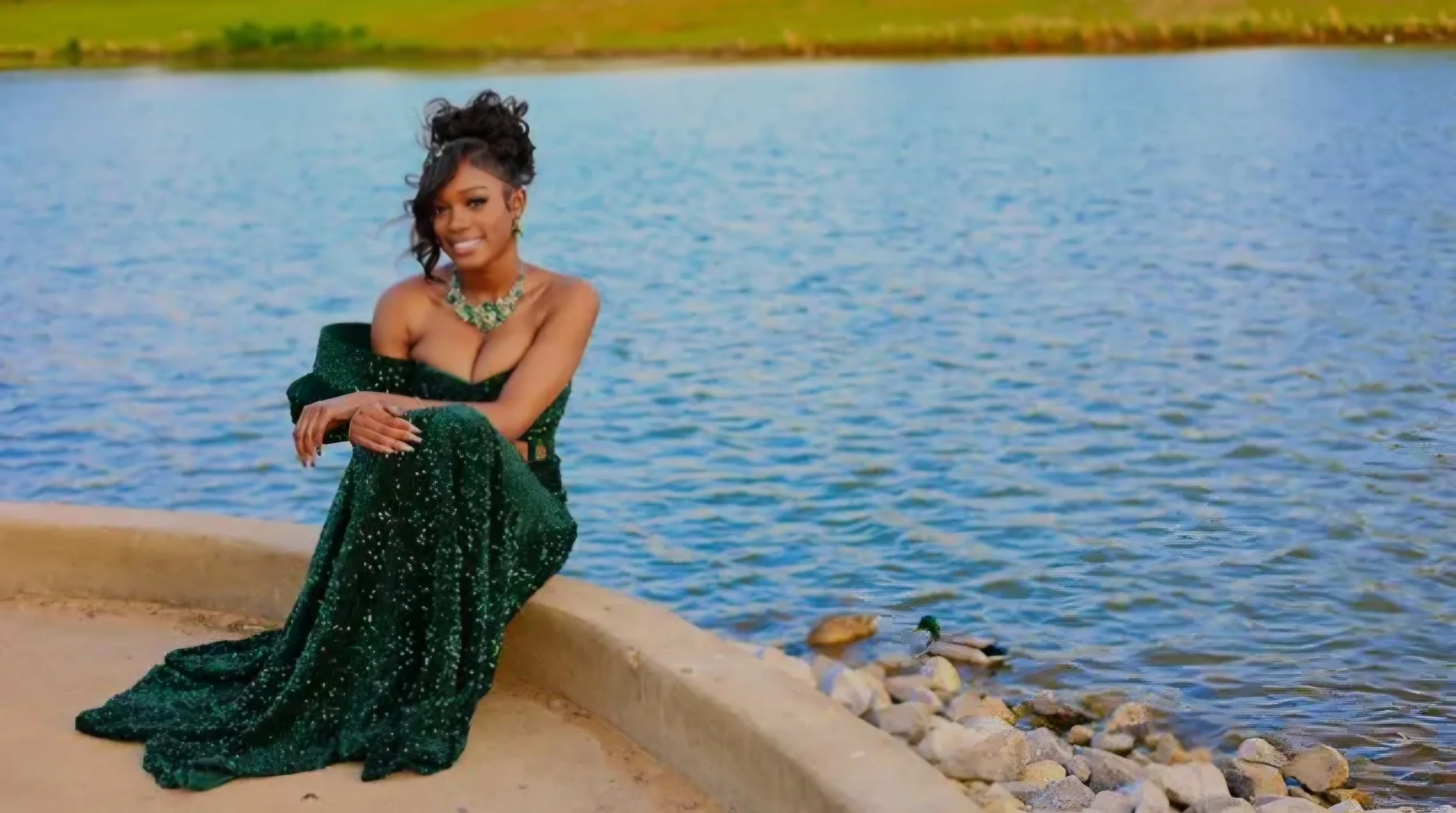
(c) Lashonte Anderson via BBC / picturing Trinity Foster from Memphis
Hustle & Flow #67 is out!
🌄 I’m publishing this from Cape Town where I’m attending FAME Week Africa, so you will excuse a slightly shorter edition this time (or perhaps you prefer it shorter? Let me know in the comments).
The month of August is typically when the investment and development worlds are OOO, so you’d expect it to be slow. It wasn’t.
In fact, Sony Innovation Fund announced two deals - I talk about them below. Also, the good: Nigerian designers take over the US prom market (is there ANYTHING Nigerians can’t do?); the bad: African creators get locked out of Etsy and Kenyans gamers of Twitch; and the necessary: my proposal for an authoritative definition of the African creative industries.
👋 If you are reading this but are not yet subscribed, what are you waiting for? Join the other 10,000+ professionals who get HUSTLE & FLOW monthly in their inbox: https://lnkd.in/drBY8jnz
INVESTMENT NEWS
While other investors were off on a beach somewhere, Sony Innovation Fund was busy closing deals.
In August, the fund announced two new bets in Africa’s creative economy: Filmmakers Mart and Twiva.
🎬 Filmmakers Mart is a production marketplace that helps filmmakers manage everything from logistics and permits to catering and crews. This is also Sony’s first co-investment with IFC - International Finance Corporation.
🤳🏾 Twiva is a Kenyan social-commerce platform where influencers become sellers. It bundles influencer marketing, fintech, live streaming, and skills training to help creators monetize at scale.
These are only Sony’s second and third investments in the space after gaming publisher Carry1st, while Filmmakers Mart is only IFC’s second direct investment in an African creative company after ANKA.
⌛️ It’s worth noting that it took about two years for these (very motivated) investors to get here, and it was not for lack of trying. That’s simply how long it takes to study a new industry, design a strategy, build trust with founders, source and vet deals, and structure investments. It is also a reflection of the lack of investable deals I often talk about.
Now that the pump has been primed, it’s in our collective interest to make sure that more solid, bankable deals keep coming to the market.
FASHION
👩🏿🎓Prom has quietly and randomly become one of Nigeria’s most lucrative fashion exports - and this lovely piece by the BBC was the feel-good story of the summer for me.
In it we see 18-year-old Brianna LeDoux from Florida flaunt her prom gown, custom-made by a Nigerian designer. Her TikTok showcasing the dress has now been viewed 1.1 million times.
Brianna is part of a fast-growing movement of US teens tapping into Nigerian glamour for their biggest night of high school.
Thanks to TikTok and Instagram, these American teenagers are discovering that Nigerian designers can offer them things that their own market can’t:
✨ First, identity & cultural pride. Many of these young ladies are from diaspora communities. For them, a Yoruba-lace gown is a proud nod to their heritage.
✨ Then, Met Gala-level originality & drama at prices that undercut US couture. If you’re familiar with Nollywood red carpet looks, you know what I’m talking about.
✨ And finally, craftsmanship & care, with orders handled over WhatsApp with video consultations, precise measurements, and handmade detailing.
On the supply side, this has created a fascinating business model:
Five African designers interviewed by the BBC shipped more than 2,800 prom gowns to the US this season alone. One workshop in Ibadan even employed 60 full-time staff and 130 seasonal tailors to handle 1,500 dresses.
At $600–$1,500, these gowns are far cheaper than custom US couture ($3,500+) while still offering high margins for the designers. If we assume an average price of $1,000 per dress, that’s $2,8 million generated by just the five designers mentioned in the BBC story - a substantial amount.
The distribution channel couldn’t be more low-cost yet efficient: TikTok builds fame, Instagram drives sales, and WhatsApp manages customer service. That’s a full global sales funnel powered by social media.
And as prom is a recurring event, it has become a reliable annual anchor for the designers, representing up to 25% of total revenue for some of them.
💡 The US success of Nigerian prom dresses gives us a potentially replicable business model for creative companies: spot a cultural moment in a diaspora community with disposable cash (prom) > link it to emotional value (identity + self-expression) > build an export pipeline around it.
Yes, there are hurdles: new US tariffs, customs delays, scale limitations. But the fundamentals are strong. This model could be extended well beyond prom dresses into weddings, lifestyle, accessories, and other cultural “milestone” markets where diaspora consumers crave uniqueness and meaning.
E-COMMERCE
Now for the less happy stories.
As of last month, many African shops have been locked out of US-based creators platform Etsy.
The reason is the platform’s consolidation of all payments under its proprietary Etsy Payments system and its phasing out standalone PayPal.
Etsy Shop’s goal is to tighten control over fees, compliance, and buyer protection, but the unintended consequence is that, since Etsy Payments isn’t available in most African markets, sellers are effectively locked out.
👶🏾 The reality is that Africa is still the smallest market for these global platforms, so they’re not incentivized to implement inclusive solutions.
🐔🥚 But without access, it will stay that way. It’s a chicken-and-egg problem: if African creators can’t plug into global commerce, they can’t grow into the kind of market size that makes integration “worth it” for the Etsys, Netflixes, and Spotifys of this world.
Solving the payment integration issue would have a transformational impact on the African creative economy’s potential to generate revenue from global markets.
It may seem like a simple problem (why can’t global platforms just integrate Flutterwave and Paystack?), but it’s actually quite complex. Reminder to self to dig into it at a later time.
GAMING
🎮 In another blow to creators and more specifically gamers, leading live-streaming service Twitch has announced that it is suspending monetization in Kenya.
Twitch cited “recently imposed regulations [that] have restricted [their] ability to continue offering Twitch monetization opportunities to streamers in Kenya.”
🤑 The company hasn’t named the rules explicitly, but the most likely culprits are Kenya’s Tax Laws (Amendment) Bill, 2024 and provisions in the Finance Bill 2024.
The Tax Laws (Amendment) Bill, signed in December 2024, imposes taxation on income earned by content creators via monetization platforms such as TikTok, Facebook, but also Twitch. This means that platforms may be forced to act as withholding agents or face compliance burdens.
Meanwhile, the Finance Bill of 2024 introduced a 1.5% levy on local digital platforms and a 6% “significant economic presence” tax on non-resident companies earning income in Kenya through digital services. Twitch is unlikely to be big enough in Kenya to qualify as “significantly present” but still, this is adding complexity.
🔚 So, rather than adapt to these new rules, Twitch has opted to exit.
And this is not surprising. Once again, for global platforms, African markets are too small to justify making any effort.
This sad state of affairs could have easily been prevented. Kenya’s creator economy (like much of Africa’s) is still in its early days, and still fragile. Instead of standing back to enable growth before capturing value, the government is enforcing blunt regulation that drives platforms away, stranding local creators in the process.
If African countries are serious about building globally competitive digital and creative economies, then regulation needs to be strategic, enabling, and forward-looking. Imposing tax and compliance rules prematurely will only result in strangling the creative economy before it even has the chance to develop.
Still in gaming but on a positive note, the play-to-earn model is back, but more grounded and without the hype.
With rising costs across Nigeria, a recent TechCabal story highlighted how the mobile app Hyper is giving gamers a chance to earn extra cash. Hyper was built by Metaverse Magna (MVM), a Nestcoin portfolio company.
Here’s how it works:
🧩 Players compete either in head-to-head matches or in daily tournaments across a catalogue of more than 20 simple mobile games. The results are transparent, with public leaderboards and prize pools showing exactly who won what. Hyper uses its own in-app currency, HPR, fixed at ₦5 per coin. Players can cash out directly to their bank accounts or PayPal.
Importantly, Hyper runs smoothly on entry-level smartphones, which makes it accessible to a wide audience.
The amounts aren’t huge, but they’re meaningful. The most skilled and consistent players can reach around ₦48,000 ($27) per month.
🛒 Why does this matter? Because it shows that play can become a modest but real income stream. These micro-earnings won’t replace a salary, but they can cover essentials like groceries or data.
This model might be one key to unlocking the revenue potential of the much-hyped-up African gaming market.
It could also, in theory, offer an on-ramp: once people get comfortable making money online in small ways, they are more likely to try other (paid) digital platforms to access music, videos, or sports, for example. At least that’s the assumption.
BACK TO THE BASICS
When engaging with investors, the first question I’m often asked is: “But what are the creative industries, exactly?”
😵💫 Turns out, this confusion is shared by many - and for good reason.
There is not one, authoritative definition out there, but several imperfect ones. To complicate matters further, they don’t say exactly the same thing.
The three most widely used definitions come from UNESCO, the UK’s Department for Culture, Media and Sport, and the UN’s Conference on Trade and Development:
🔹UNESCO defines the cultural industries as sectors that safeguard and promote cultural identity and diversity, rooted in heritage and cultural expression. No economic angle.
🔹The UK’s DCMS frames the creative industries as those that draw on individual creativity and intellectual property to generate jobs and drive economic growth. Sounds pretty good, until you realize that they include software (?!).
🔹UNCTAD presents the creative economy as a hybrid framework linking culture, trade, and development, with particular relevance for the Global South. Too development-y.
Some African institutions and countries have tried to come up with their own spin on those, but so far, none has stuck.
Personally, I don’t like those that include terms like “livelihoods”, “informal”, “identity” or “youth”. They may be factually correct, but they make us look small and needy.
So, you know what I had to do. I took matters into my own hands.
I hereby present you my definition:
🌟 “The African Cultural and Creative Industries are the sectors that harness and showcase the continent’s cultures, creativity, and intellectual property to produce goods and services that generate economic growth, create employment, and project Africa’s soft power globally.”
The following 11 sub-sectors are included in this definition:
1. Audio-Visual Media & Entertainment: Film and cinema; Television and broadcasting; Radio; Music (recorded + live + streaming); Animation and VFX; Video games and esports; Streaming and on-demand platforms
2. Design & Fashion: Fashion design (luxury, ready-to-wear, traditional attire); Accessories and footwear; Interior design, homeware and décor; Graphic design, industrial/product design
3. Lifestyle, Beauty & Gastronomy: Beauty and cosmetics rooted in indigenous knowledge and aesthetics; Hairstyling and body art (braiding, barbershops, henna, adornment); Gastronomy and culinary arts (restaurants, chefs, street food, beverages); Cultural food products (indigenous superfoods, teas, drinks like palm wine, rooibos)
4. Sport & Entertainment: Professional and amateur sports as entertainment; Sports media, broadcasting, and event management; Esports (overlaps with digital media); Mega sporting events as cultural spectacles
5. Creative Business Services: Advertising and branding; Marketing and communications; Architecture and urban design; Creative consulting
6. Digital & New Media: Creator Economy and Digital content creation; Online streaming and distribution platforms; Virtual/augmented/mixed reality for culture and storytelling; NFTs and digital art marketplaces; Creative tech
7. Cultural Tourism: Heritage and museum tourism; Festival and event tourism; Creative city branding
8. Publishing & Literature: Books and e-books; Newspapers, magazines, periodicals; Comics, graphic novels; Children’s and young adult literature; Digital publishing and blogging
9. Performing Arts: Live theatre and performance; Dance (traditional, contemporary, urban); Festivals and cultural events; Music concerts (overlaps with audiovisual)
10. Visual Arts & Crafts: Painting, sculpture, photography; Handicrafts, textiles, ceramics, jewelry; Galleries and exhibitions
11. Heritage & Traditional Knowledge: Museums, archives, libraries; Cultural heritage sites and monuments; Indigenous knowledge, oral traditions, folklore; Crafts and artisanal products
What do you think? Am I missing anything?
🚨 If it resonates with you, I’m asking for your help to turn it into THE definition for the African creative economy. Please use it, share it, advocate for it.
Asante sana 🙏