
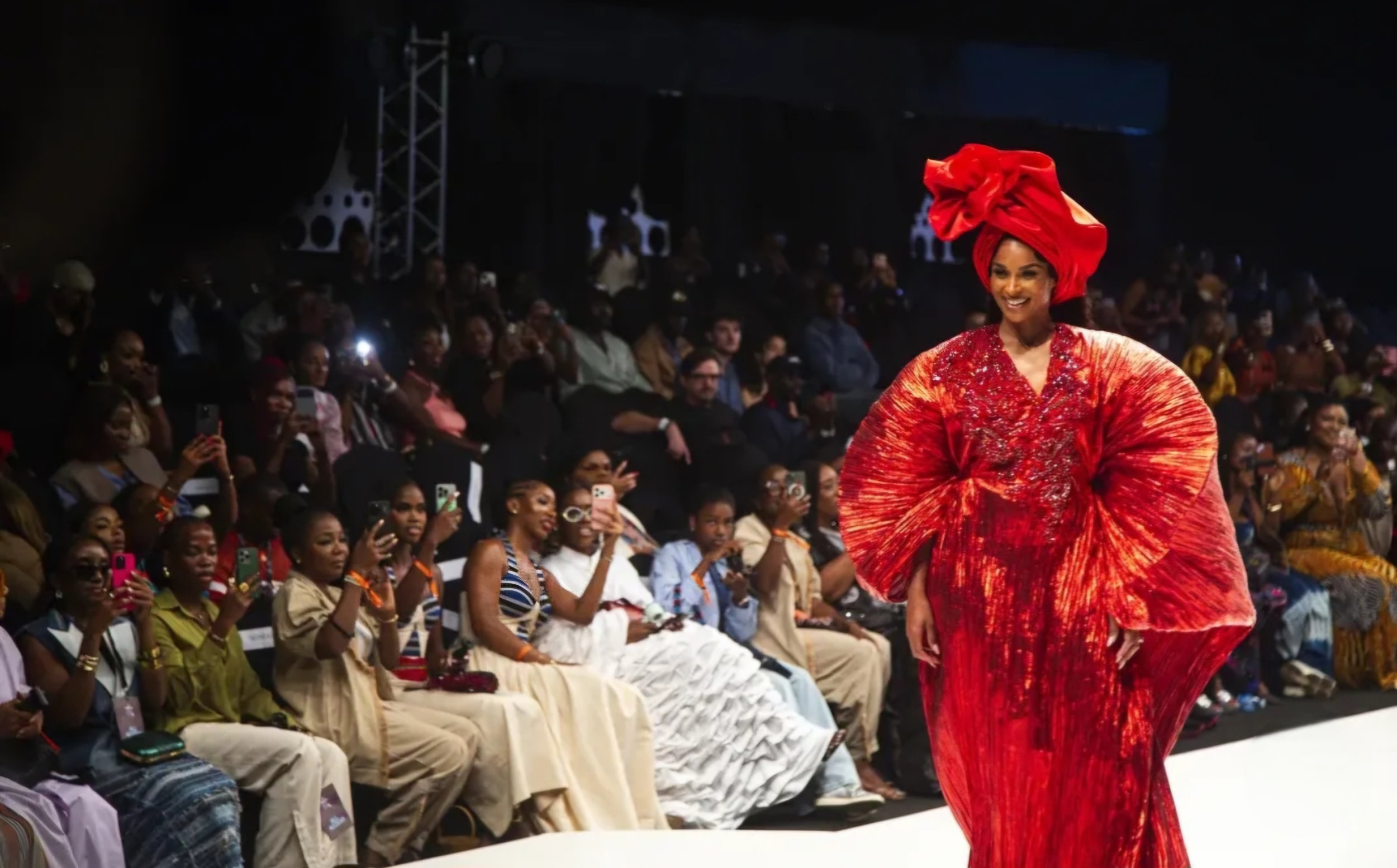
Ciara walking the runway for Fruche at Lagos Fashion Week 2025
The new edition of Hustle & Flow is out!
A bit late - apologies for that.
✈️ I’ve been shuttling between Johannesburg, Lagos and London this past month and, despite how well I’ve trained my ChatGPT BFF, it still cannot write this newsletter for me.
🗽And there is A LOT going on at the moment. Just the other day, a Ugandan rapper formerly known as Young Cardamom became the new mayor of New York. Imagine.
In this edition, I talk about exporting African fashion, ANKA’s surprise acquisition, the rise of creative Saas, the new partnership between Afro Nation and PFL Africa, and what conference organizers can learn from the Creation Africa Forum.
Among, as usual, various other things.
If you don’t subscribe already, join the party: https://lnkd.in/drBY8jnz
It starts here 👇
BROADCAST
✂️ Cost-cutting has started at Canal+ Africa (the new name for the Canal+Multichoice merged entity).
You may remember that as part of the public-interest conditions attached to the deal’s approval by South Africa’s competition authorities, Canal+ agreed to a 3-year moratorium on merger-related retrenchments in SA, and to a substantial, sustained spend in local content and in supplier development and procurement.
And yet.
🏷️ Last week, the company demanded a blanket 20% discount on all invoices from MultiChoice’s service providers.
This concerns all vendors, from office suppliers to production houses and even new contractors. Payments have been frozen while negotiations take place.
🧊 The reality is that Canal+ paid a rich price ($3 billion in total) to acquire a group facing financial losses, mounting competitive and macroeconomic pressures, and whose legacy Pay TV business is melting like an ice cube in the Kalahari desert.
So “synergies”, aka cost-cutting, were always on the horizon.
But the blanket cut seems like a particularly blunt instrument, especially considering that many of Multichoice’s 3,269 independent providers are small and mid-size enterprises, and probably quite vulnerable to such a brutal change in payment terms from a big client.
This also seems completely contradictory to the “supplier development” condition Canal+ had previously agreed to. Ask for forgiveness, not permission, I guess?
Anyway, the Competition Commission is looking into this.
STREAMING
Nazrawi “Naz” Ghebreselasie, CEO of Kana TV, has written a sharp operator-lens piece on the realities of streaming in Africa.
For context, Kana TV is Ethiopia’s leading entertainment channel and one of the 12 case studies I profiled in my Proparco CREA Fund report, Success Stories in the Creative Industries in Africa and other Emerging Markets.
💡 Particularly enlightening is Naz’s breakdown of streaming’s unit economics in Africa, where the toxic mix of low ARPU and high server costs means that audience growth actually leads to deepening losses - an issue I became familiar with during my Buni.tv days.
If you work in media, sports, or telco on the continent, the full piece is a must-read.
FASHION
Lagos’ art season is in full bloom, and although I sadly missed ArtX, AFRIFF, Lagos Photo and Lagos Design Week, I did make it to Lagos Fashion Week.
(For some behind-the-scenes content that does not make it to Linkedin, head over to Instagram @marieloramungai and check out my stories and highlights.)
I was there with some investors to dig into African fashion’s export potential, and how we can unlock it.
📈 In the past few years, soft signals (social media virality, celebrity endorsements) have been telling us that the global desirability of African aesthetics and brand stories is rising.
African Fashion’s emphasis on craftsmanship, sustainability, and culture is resonating worldwide.
🌍 The key to global market entry is the diaspora -- roughly 42 million Afro-descendants in the US, 10 million in the EU and 2.5 million in the UK.
Diasporans are engaged with the culture and willing to spend (in hard currency) far more than most consumers on the continent can.
Yet, getting from “admired online” to “bought and worn” is still hard.
Here’s what gets in the way:
📢 Awareness and trust. Many shoppers abroad don’t know the brands yet, or worry about quality, sizing, shipping, and returns - all valid concerns.
📦 Shipping, customs duties and VAT. These extra costs can make a garment 25-40% more expensive by the time it lands in Europe. The US market used to be easier and cheaper to access, but Trump’s new tariffs and the end of the AGOA treaty are changing the rules of the game.
Right now, some top brands like Dye Lab, This is Us, Torlowei or Banke Kuku are working around these challenges by organizing pop-ups in London, New York, or Atlanta.
Shoppers line up around street corners and drops often sell out in a few days or even a few hours. When people can touch the fabrics and try on the clothes, they buy.
But pop-ups are time-consuming and hard to scale, so this can only be a temporary strategy.
Where do we go from here?
💠 Exporting needs to become simpler. Brands need clear guidance on tariffs and paperwork, pooled logistics, and local return points in the US/EU. If you’re working on these topics, let’s chat.
💠 We must build routes to market beyond Direct To Customer. Diarrablu has been very successful at building relationships with major US retailers such as Nordstrom or Anthropology. That’s an example to study and emulate.
💠 Financiers should offer working capital solutions tied to overseas orders, so brands aren’t stuck doing luggage drops and weekend pop-ups forever.
The demand is there, the taste is there, and the diaspora is ready. Efforts now need to go towards reducing friction.
🇬🇭 Just across the border, Ghana made a big move in favor of African fashion and creative IP: it formally granted Kente cloth Geographical Indication (GI) status.
GI is the same legal shield that protects Champagne in France or Darjeeling tea in India.
In plain terms: only authentic, hand-woven Kente from Ghana’s certified weaving communities can now be marketed as “Kente.”
It’s a big deal because:
💠 GI protection makes it harder for counterfeits (I’m looking at you Shein and Temu) to undercut Ghanaian weavers and helps keep more value in local hands.
💠 Every genuine piece will carry a scannable code that verifies where it was woven and by whom.
💠 Historic hubs such as Bonwire, Adanwomase, Agotime-Kpetoe will be able to get formal recognition in the value chain.
Now the real work begins: certification management, brand enforcement across markets, and smart licensing so fashion houses can collaborate without erasing provenance.
E-COMMERCE
They’ve also done a lot for African fashion:
ANKA (ex-Afrikrea) has been acquired by Global Shop Group, a New York–based company led by Matilda Ceesay.
The price was not disclosed. ANKA’s team, operations and branding will remain, with leadership transitioning to Ceesay.
With $13.5 million raised since its launch in 2016, ANKA is one of Africa’s most prominent CreaTeach startups.
⚙️ A little over a year ago, it pivoted from an ecommerce marketplace (Afrikrea), to a software-as-a-service solution (SaaS), combining a marketplace, a payment system, and logistics services, allowing it to quadruple its payment volume and reach breakeven with $4.1M revenue in 2024.
According to the company, it processed >$60m in transactions across 175 countries over the past year and supported 10,000+ jobs across 46 African countries since inception.
Moulaye Taboure, exiting CEO, also invested a lot of personal time and energy in sharing his knowledge with the entrepreneur community.
😅 After more than 10 years, I can imagine that he and his co-founders may feel that they’ve done their part (I’ve been there).
Either way we look at it, ANKA’s impact on the African Creative Industries has been undeniable.
So who’s buying?
Global Shop is a young vehicle (≈1 year old). Its CEO Matilda Ceesay has a fashion-ops, product, and tech background (ex-Nike, ex-BCG; MIT/Cornell).
👷🏾 Translation: this looks less like a “big check” roll-up, and more like an operator-led push to sharpen ANKA’s US go-to-market.
Considering that (despite the tensions around tariffs), the US market is by far the most lucrative for African creative goods due to its strong diaspora, this handover could usher in an interesting new era for ANKA.
I’ll be looking forward to Ceesay’s next moves.
CREATECH
ANKA’s trajectory from marketplace to SaaS solution actually pioneered a new trend that I now see being replicated across the continent and across creative sub-sectors.
I call it the “rise of the Creative SaaS”.
👋🏾 Goodbye, clunky streaming services, deserted fashion ecommerce sites and gig listing platforms with 12 users.
Smart createch founders across Africa have now caught on that what the industry truly needs is operating systems that standardize workflows, production, payments, logistics and data analytics.
Some would call these unsexy, but not me.
Because I like businesses that make sense and also, crucially, money.
Here’s just a few examples of companies building the much-needed rails for Africa’s creative class:
🎬 Filmmakers Mart is a production OS for crews, locations, permits, payroll and set logistics.
🤳🏿 Selar provides a full stack enabling creators to sell courses, memberships, tickets and digital goods, with fast local/FX payouts.
🎧 Makerverse handles rights, splits, distribution, analytics and cross-border payments for independent music labels, aggregators and communities.
👗 Stylebitt is an OS for fashion businesses and independent tailors, digitizing orders, measurements, costing and fulfillment.
🎤 HustleSasa provides ticketing, logistics and cash advance solutions for live events.
🎞️ Fusion Intelligence develops cinema software that includes ticketing, box office reporting, as well as community-cinema infrastructure.
💅🏾 Splice helps beauty salons manage bookings, payments, staff, loyalty programs and inventory.
All these companies are targeting fragmented supply chains in dire need of standardized tools and user-friendly tech to replace Google spreadsheets or even written records.
This may just be the meet-cute moment between creative and tech that we’ve been waiting for.
SPORTS BUSINESS
Leading Afrobeats festival Afro Nation has inked a multi-year deal to programme live entertainment around Professional Fighters League (PFL) Africa events.
🎵🥊 But this is not just a cool “Afrobeats meets MMA” partnership - it is a portfolio-synergy play by Helios Sports and Entertainment Group (HSEG), the investor behind both ventures.
Besides PFL Africa and The Malachite Group, which owns Afro Nation, HSEG also backs NBA Africa and the Zaria Group, developer of the Zaria Court entertainment complex in Kigali.
🎡 HSEG’s strategy is to invest in premium sports and entertainment assets and create a flywheel across sports IP, festival IP, venues and hospitality that can bundle sponsorships, share audience data, cross-market talent, and extend monetisation from tickets to media, merch, and hospitality.
In theory, this is a very powerful approach.
In practice everything will, of course, depend on execution, and also on HSEG’s ability to keep its own investors happy for the time that it will take to generate returns, which may take a while.
A useful comparison:
In pre-pandemic times, Vivendi’s CanalOlympia tried to fuse cinema (powered by Canal+ and StudioCanal) and music (from Universal Music) via a bricks-and-mortar network of venues across 12 countries.
💥 It was a good idea. But the difficult timing, coupled with some strategic mistakes (locations in small countries and outside city centers, only one cinema screen), the lack of flexibility of the model, and Vivendi group’s loss of interest in the project ultimately led to its failure.
We can only hope that HSEG will be both quicker (to learn and pivot) and more patient.
⚽️ CAF is back in the black.
In early October, CAF reported a $9.48M net profit on $166.4M in revenue for FY 2023/24, its first surplus in years.
📈 Growth was driven by new sponsorships, stronger broadcast income, and tighter financial controls.
That’s great news for the institution, but also for African football as a whole, as a healthier CAF can push cash downstream to clubs, leagues, and women’s football, improving product quality which in turn reinforces media rights and sponsorship value.
Up next is AFCON Morocco 2025, which is projected to be the most lucrative edition yet - if it’s not disrupted by Moroccan youths protesting for more hospitals, less football stadiums.
EVENTS
A big highlight of the past month has been the great experience I’ve had co-hosting the Creation Africa Forum in Lagos.
Organized by the French Ministry of Foreign Affairs and MansA Maison des Mondes Africains, the event gathered 1000+ participants, including 80+ speakers.
It also delivered a masterclass on what a useful (and fun) creative industries convening can look like.
What did they do differently?
Event organizers, please take note.
🔍 Sharp curation from actual industry experts.
From projects’ selection to discussion topics, Creation Africa's content was on point. No basic panel titled “Structuring the African CCI”, but targeted sessions with proper editorial angles aimed at an audience of professionals (no students, no randos).
🌍 A true panafrican scope.
The French Ministry of Foreign Affairs and MansA invited (and paid for! 🤯) 400 African creatives from 42 African countries to attend the event. And they mixed and matched them throughout the program, ensuring maximum cross-continental pollination.
🤝🏾 A bridge to the diaspora and foreign partners.
Key members of the diaspora (Ogas such as Sebastien Onomo or Pape Boye) were invited to share their experience, expertise and networks. French creative partners and investors were there too, ready to make deals and dance on Amapiano beats during the opening soirée.
🔗 An organized way to connect.
Participants could set up meetings ahead of time through the platform b2match, ensuring that no one was running around in a vacuum screaming “Can you hear me? Where are you?” on their phones. In fact, 800+ meetings were organized during the event (excluding impromptu ones!).
👌🏾 Diverse and pertinent content formats.
Keynotes, fireside chats, panels, in-depth case studies, hands-on workshops, report presentations, pitch sessions, plus parties, exhibitions, a food court, a pop up store, and world premieres. No boredom detected.
🌟 Stars, but the ones that matter.
Not the ones organizers invite so they can say “my friend so-and-so” at their next dinner party. Instead, inspiring professionals whose trajectory and insights are directly relevant to the audience:
Kenyan award-winning concept artist Yvonne Muinde, best known for her work on Hollywood hits like Avatar and Planet of the Apes.
French-Beninese Fif Tobossi, co-founder of groundbreaking francophone rap media Booska-P.
Or Nigerian business icon and philanthropist Aigboje Aig-Imoukhuede, who I interviewed about the intersection between creativity and business.
A new standard has been set.