
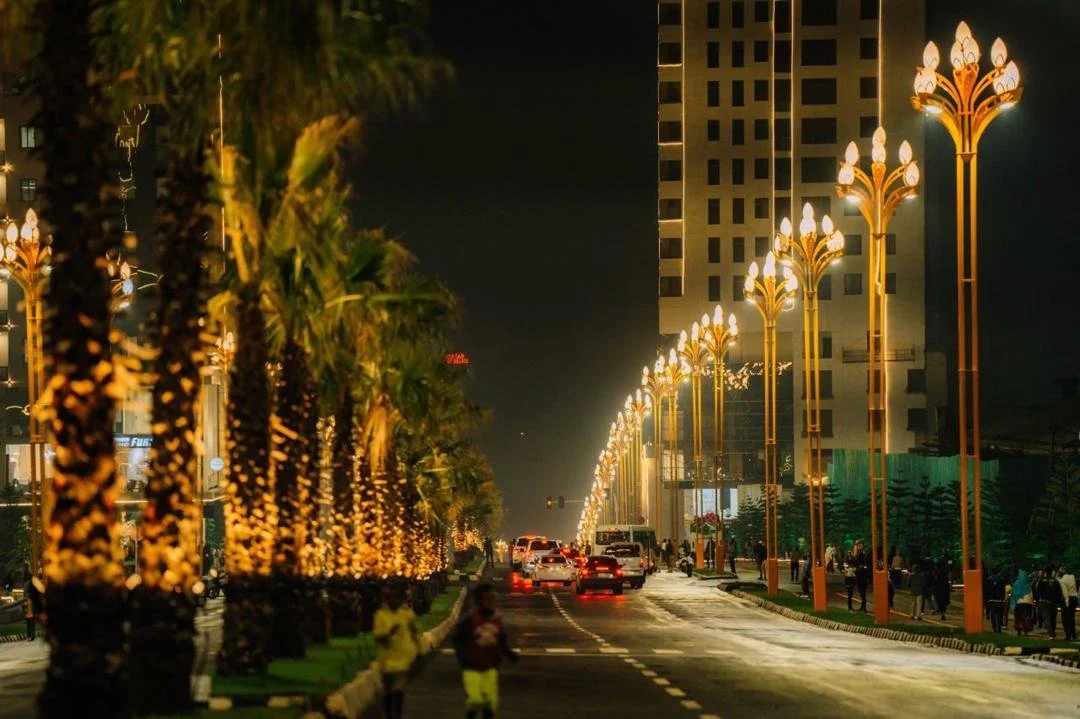
February was a long-overdue return to East Africa for me - a region I roamed extensively during my decade as a Nairobi-based journalist and entrepreneur.
🇪🇹 First, Addis Ababa, where I gave masterclasses to a network of East African creative hubs.
🇰🇪 Then, Nairobi for the Sankalp Africa Summit.
I hadn’t been back to Addis in more than 15 years, and the city deserves a moment in this newsletter.
My recent engagement made me think deep about the role that creative hubs could - and should - be having in this ecosystem. I share my thoughts here. I also talk about why investors need to stop separating fashion from textiles, IFC’s new creative bet, the quiet rise of African auteur cinema, AFCON’s win for Morocco, and the hype around vertical dramas.
Let’s go. 👇
ADDIS ABABA, CREATIVE CITY
🎄 My first impressions, after the first breath of fresh, high-altitude Ethiopian air: the country’s “corridor policy” means new roads everywhere, new buildings, but also new parks with fully-grown trees and Vegas-style fountains. Streets lit like Christmas trees at night. The city has moved and is moving.
My group still got sick from eating at a local joint though. Food poisoning remains part of Ethiopia’s charm for now.
I only had three days on the ground and time to visit only a few places: Habesha Creative Lab (where I was holding my sessions), Zeleman agency and Kana TV. But that was enough for me to be able to say this: Ethiopia’s place in the African creative landscape is seriously underrated.
Ethiopia, like most African countries, has no dedicated creative industry policy. But that has never stopped creatives and entrepreneurs from doing their thing, and in Addis, the sector’s energy was evident.
🎮 The Habesha Creative Lab (opened in May 2025 at the Alliance Ethio-Francaise, where my sessions took place) is the newest player in Addis’ modest but real hub ecosystem that also includes iceaddis (launched in 2011 - the original tech incubator) and Creative Hub Ethiopia. The Habesha Creative Lab explicitly targets digital creative sectors such gaming, VR, AR, animation, and AI. The first cohort incubated and trained 14 creative entrepreneurs with perfect gender balance. It will be interesting to track their journey.
🎯 My next stop was at Zeleman, Ethiopia’s largest and most influential creative agency which provides 360 services to the biggest companies operating in the country - from advertising, to branding, events, PR, social media, data analytics, strategic communications and leadership training. Founded by award-winning filmmaker and entrepreneur Zelalem Woldemariam, it has shaped much of the country’s contemporary visual and brand language for the past 20 years.
To give you an idea of how important the company is: Zeleman was the local production partner for iShowSpeed’s Ethiopia stop on his Africa tour for example, handling on-ground logistics, media production, and local amplification.
Two things that struck me as I toured the agency:
First, Zeleman already integrates AI in all its workflows and is even about to open an AI-only department. No amount of resting-on-your-laurels detected here.
Second, 15 years ago, I struggled to find a translator who actually spoke English in Addis. Now, Zeleman’s 140 staff communicate in English among themselves. Gen Zs are more comfortable with it than with Ahmaric, Zelalem told me, because of YouTube and TikTok. Wow.
📺 Then, I went to visit Kana TV, Ethiopia’s most-watched private entertainment broadcaster. I’ve talked about Kana TV before. In fact, it is one of the 12 African creative success stories I profiled in my report for Proparco’s CREA Fund. If social media overuse has destroyed your ability to read a few pages of prose, I also made a Linkedin carousel version, so no excuse.
The story of Kana TV is one of grit and ingenuity. It launched in 2016 backed by Moby Group (known for starting TV channels in impossible markets, such as Afghanistan) and rapidly captured 40–50% of prime-time TV viewing by initially acquiring and dubbing Turkish series into Amharic, proving there was a massive, unmet appetite for high-quality, localized entertainment.
What Kana TV did was rewire Ethiopia’s media economy: it forced competitors and regulators to rethink production norms and content policies, introduced Ethiopian SMEs to TV advertising, and spurred investment into local shows alongside dubbed content. Today, Kana TV produces its own programs, blending quality entertainment with operational efficiency. A team was shooting something in the open space during my meeting with CEO Nazrawi “Naz” Ghebreselasie, for example.
Talking about Naz, his own story is like a movie: a solo Ethiopian refugee to Canada at 16 years old, he studied physics first, then became the country’s math champion. Now he actually applies classical mathematical formulas to improve Kana TV’s programming strategy. And, spoiler alert, it works.
🥸 Ethiopians are famously humble and very uncomfortable with showcasing personal achievements. I hope Zelalem and Naz will forgive me for putting them in the spotlight, but they know I’m doing this because the continent’s creative entrepreneurs need role models and stories of homegrown success.
So, you got it - the level of creative drive and innovation in Addis impressed me. I’ll be back in a couple months for CRAFT Addis, the country’s first creative economy gathering organized with great ambition by Zeleman.
CREATIVE HUBS, THE MISSING NODE
The reason I went to Addis in the first place was to work with an East African network of creative hubs and help them think through their transition from fully donor-funded to a more sustainable model.
What I found confirmed something I’ve suspected for a while: these hubs sit at the most strategic infrastructure layer in the entire ecosystem but are almost universally under-positioned.
Cultural and Creative hubs come in many shapes. Most were established with donor support. Some sit inside cultural centres or embassies, while others are offshoots of existing tech hubs. What they share is a confusion about what they are actually for:
Is the goal to support innovative artistic creation?
To train young creatives for employment?
To incubate bankable creative enterprises?
All of the above?
🤔 Part of the confusion is rooted in a deeper misunderstanding: culture and creative industries are related, but they are not interchangeable. Culture is about expression, identity, and heritage. Creative industries operate as market systems involving IP, distribution, monetization rails, supply chains, and capital structures. Culture requires support; creative industries attract investment.
When a hub tries to straddle both without clarity, it becomes diluted. It can host workshops, organise showcases, rent desks or equipment, but misses the opportunity to systematically shape the market.
💵 Another challenge is the distortion in approach and expectations caused by the VC narrative. Tech has dominated Africa’s investment conversation for a decade, and it’s left most people believing that companies = startups and investment = VC.
In fact, this couldn’t be further from the truth. Over 90% of creative companies are SMEs: fashion labels, production houses, studios, agencies, publishers. They are often profitable, labor-intensive, and rarely capable of 10x growth in three years. Forcing them into the VC template pushes them to invent inflated TAMs to impress VC funds that will leave demo days unimpressed anyway, reinforcing the idea that creative industries are “uninvestable.”
These SMEs are not uninvestable, they’re just talking to the wrong audience. Financial instruments adapted to creative businesses - working capital, invoice factoring, revenue-based financing, angel checks, micro-PE - do exist and are becoming increasingly available. Yes, this is a very complex and opaque world to navigate. But hubs need to build this financial literacy so they can direct founders toward the right doors.
Sitting between creatives, schools, corporates, governments, donors, and investors, hubs have the potential to become the most important infrastructure layer in the African creative economy. Specifically as:
1️⃣ Market intelligence centers. The data on African CCIs is disjointed. Hubs could be the ones to connect the dots: which subsectors are growing locally, where distribution bottlenecks sit, what infrastructure is missing. Over time, the hub becomes the reference node for its territory.
2️⃣ Talent pipelines for the real economy. Creative skills are valuable beyond the creative sector. Consumer brands need social media managers, mining companies use VR for staff training, retailers need brand designers. Hubs could bridge the gap and widen employment paths.
3️⃣ Pre-investment filters for financiers. DFIs and funds are actively seeking structured creative deals, but cite weak financial literacy and informal structures as reasons for slow deployment. Hubs are the ideal partner for business readiness programmes, the step that must come even before investment-readiness. That makes them a trusted filter for capital.
The repositioning is deep work. It requires hubs to define their mandate clearly, build internal finance capacity, and extend their networks beyond the cultural circuit toward banks, investors, and export agencies. And critically: hubs need to see themselves as businesses too. Staying grant-dependent makes it impossible to operate with the long-term discipline that serious pipeline-building requires. But the potential is enormous - and exciting.
FASHION & TEXTILE
After Addis, I was off to Nairobi for the Sankalp Africa Summit, where I gave a masterclass on Investing in the African Creative Industries and moderated a panel on “From Craft to Capital: The Fashion and Textile Industry as an Engine of Trade, Climate Action, and Employment.”
The speakers - Wandia Gichuru (Vivo Fashion Group, Kenya), Yayra Agbofah (The Revival, Ghana), Mary Porter Peschka (IFC East Africa), and Maaza Dikker Hupkes (GIZ, Ethiopia) - surfaced a structural argument that more investors and governments need to hear.
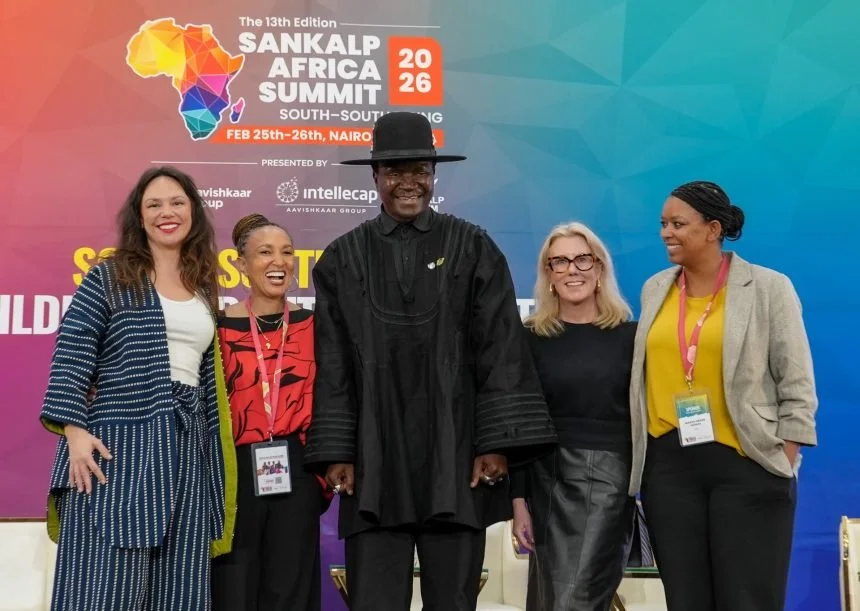
(c) Sankalp Africa Summit 2026
Traditionally, textile is treated as “industry,” 🏭 while fashion is treated as “creativity.” 👗 In government ministries, textiles sit under manufacturing or agriculture and fashion sits under culture.
♻️ But this separation is artificial: fashion and textile are very much part of the same value chain. Cotton is grown, fibers are spun, fabric is woven, garments are manufactured, brands create demand, consumers buy, and eventually waste must be absorbed. Textile capacity without demand for garments is idle infrastructure and fashion without manufacturing capacity is constrained growth. The two depend on each other.
And that’s important because Fashion & Textiles are probably the creative sub-sector with the most direct link to impact.
Textile and apparel manufacturing are historically the entry point into formal industrial jobs in emerging economies, particularly for women and young workers. Kenya’s Vivo Fashion Group is one of the best local case studies in that regard, with 30+ stores across East Africa and roughly 450 employees (mostly women). I also profiled Vivo in the CREA Fund report, and the short-attention-span-friendly version is here. Key to the story: Vivo built that scale by serving domestic consumers while producing locally.
Because yes, if you want jobs at scale in this sector, you do need people to buy clothes. This can contradict the other reality, which is that the global fashion industry is resource-intensive, and famously one of the most polluting in the world. African countries drown under millions of tons of second-hand clothes from the West that flood markets like Kantamanto in Ghana.
But, as Wandia Gichuru put it, Africa is downstream in the waste chain, not upstream in the overproduction model. The surplus is not produced in Africa, but elsewhere. The real question is not whether Africa should industrialize in textiles, but whether it can build a cleaner industrial model from the outset. GIZ’s Sustainable Industrial Clusters programme in Ethiopia, which is focused on wastewater treatment, water use reductions, renewable energy, and worker standards, shows this is possible at cluster level.
Investors readily finance factories and industrial parks. Creative economy capital focuses on storytelling and design but is less equipped to assess supply chains and compliance. The result is that textiles are funded as industrial assets, fashion is funded as fragmented SMEs, and the system as a whole is under-capitalized.
Reframing fashion and textiles as one asset class would recognize that the sector’s creativity and soft power, labor intensity, gender profile, and export potential align naturally with impact mandates.
Working capital for brands, access-to-market efforts, compliance financing for factories, cluster-level environmental upgrades, but also textile and trade policy reforms, should not sit in separate silos. They are components of one competitive ecosystem.
INVESTMENT
Now on to the more newsy part of this newsletter.
🤝 IFC has “signed a mandate partnership with” (translation: they are investing in) TerraKulture, Lagos's 23-year-old cultural institution founded by Bolanle Austen-Peters, to support the refurbishment and expansion of its creative and training facilities.
The announcement mentioned inclusive growth, cultural expression and job creation, and those themes are definitely key to both institutions. But the more interesting story is elsewhere: what actually made this deal possible is that TerraKulture is a real business.
TerraKulture is not a passion project that convinced a DFI to take a leap of faith. It is a multi-revenue, multi-decade institution that has quietly built one of the most diversified business models in Nigeria's creative sector.
🎭 First, TerraKulture is what we can call a “multi-purpose venue”: the location comprises a 400-seat theatre, an art gallery, a bookstore, and a popular restaurant. On top of that physical infrastructure, TerraKulture runs well-known creative training and skills development programs, partly funded by donors such as Mastercard. And then there's the content arm, which includes blockbuster original theatre and film productions. The result is a solid company with physical and IP assets that generates a couple million dollars in annual revenue across several revenue streams.
IFC does believe in TerraKulture’s cultural mission, but the real reason it was able to back it is because the numbers work, the model is diversified, and the governance is solid enough to absorb institutional money.
FILM
🎥 African auteur cinema seems to have finally cracked the international festival circuit in a way that finally feels sustained rather than exceptional.
🏆 In the past year, the lineup has gone from sporadic to proper: On Becoming a Guinea Fowl (Zambia), My Father’s Shadow (Nigeria), How to Build a Library (Kenya), Khartoum (Sudan), Lady (Nigeria), Dao (Senegal), and Soumsoum (Chad) have been noticed at Cannes, Sundance or Berlin.
My Father’s Shadow went on to win a BAFTA last week, confirming that African auteur films are also entering the mainstream awards conversation, and not just the festival circuit.
Meanwhile, Djimon Hounsou has joined other leading diaspora actors such as Idris Elba and David Oyelowo in launching his own production company focused on developing African stories.
African storytelling is becoming competitive and valued at the highest global levels, which matters for reputation, deal-flow, and future financing. It also makes the case for institutional capital to step in earlier. We’re seeing early signs of this with Afreximbank’s CANEX INC and Nigeria’s MBO Capital backing Clarissa by Arie and Chuko Esiri.
Clarissa was acquired for worldwide distribution by NEON, while My Father’s Shadow was picked up by MUBI, signaling that the space is growing for premium, globally positioned African content.
However, don’t be fooled: these two films are very much outliers, star actors also struggle to produce African films, and festival recognition doesn’t fix the wider distribution problem.
⚠️ At the mass-market level both in Africa and globally, distribution has collapsed and the film industry is experiencing serious disruption because of fast consolidation among buyers and platforms, a corrective move on previous overspend, and of course, AI.
I spoke to Variety about the dichotomy between festival success and the distribution bottleneck. What gives me hope is that the distribution picture is structurally difficult, but not static. A few things are making me cautiously optimistic:
1️⃣ Local experimentation is happening. African industry professionals are not sitting idle. EbonyLifeON+, Kava, and Circuits are various examples of Nigerian platforms attempting different models. I remain skeptical about the long-term economics of purely local streaming, but it matters that alternatives are being attempted.
2️⃣ Theatrical exhibition is quietly bouncing back. The Nollywood box office shattered records this past year. Pathé is also expanding its cinema footprint in Francophone Africa. Cinemas still have legs on the continent.
3️⃣ Non-traditional models are getting smarter. Fusion Intelligence is one example of a company in Nigeria approaching distribution through technology and software to enable a network of community cinemas. That’s interesting.
With fewer illusions about easy scale, and more experimentation with format and technology, we could argue that the African film industry is in a healthier place than when it was obliviously dependent on global streamers who could - and did - pivot away overnight.
VERTICAL DRAMAS
🤳🏾 If you work in media circles in LA, Seoul, or Beijing right now, one term keeps coming up: vertical dramas. In Africa? Almost silence.
I’ve been meaning to write about this for a while. My friend and industry colleague David Adeleke and his team at Communiqué beat me to it with a very solid piece: “Nollywood’s Billion Dollar Microdrama Opportunity.” I strongly recommend reading it for the data, numbers, and market sizing.
The article’s core thesis is simple but powerful: vertical microdramas (ultra-short, serialized, mobile-native fiction designed for smartphone consumption) have already exploded into a multi-billion-dollar business in China and are now scaling aggressively in the US and Southeast Asia.
These are not basic TikTok stories but structured, addictive narrative products engineered for monetization through micro-payments and subscriptions, driven by aggressive cliffhangers and data-driven storytelling.
The economics are radically different from traditional film and TV: lower production budgets, faster turnaround, direct monetization from audiences, and no gatekeepers.
For Nollywood, the argument is that this could represent a new distribution rail and a new cash engine that bypasses the structural bottlenecks we keep complaining about: retreating streamers, weak broadcasters, fragile cinema infrastructure.
Of course, pricing, payment integration, and purchasing power are real constraints. But the format is inherently aligned with a mobile-first market such as Africa.
I’ll write more soon about this new medium and where I think the opportunity lies for Africa, so consider this a teaser. Stay tuned 👀
SPORTS
The AFCON final was, well, not ideal.
In the end, Morocco lost against Senegal on the pitch. But it won somewhere else: in the wallet.
According to CAF, AFCON 2025 generated 90% more revenue than any previous edition thanks to its record 23 partners (compared to 17 for AFCON 2023 and 9 for AFCON 2021). In 2025, the event attracted sponsors from the United States, China, Germany, Japan, Turkey, and the UK, enjoying a truly global commercial footprint for the first time.
🏆 Meanwhile, the prize pool doubled compared to recent editions, with the winner taking home a record $10 million as part of a total $32 million pot.
Morocco's Commerce Minister also stated that the tournament generated over €1.5 billion in direct revenue, funded 80% of the infrastructure needed for the 2030 FIFA World Cup, and created over 100,000 jobs. "We gained a decade of development in 24 months," he said.
Now, some of this could be PR. But what we know for sure is that five of the six stadiums designated for the 2030 World Cup were successfully tested during AFCON. Morocco compressed what would typically require a decade of infrastructure development into two years 🤯.
For African governments and investors watching from the sidelines: Morocco just proved that hosting a major African sporting event doesn’t have to be a cost center. The returns, when the infrastructure is thoughtfully planned, spill far beyond the pitch into tourism, construction, technology procurement, hospitality and logistics.
For the African sports ecosystem more broadly, AFCON's commercial evolution is not just good news for CAF. A richer, better-run continental football body means more money flowing downstream. If the governance holds of course.