
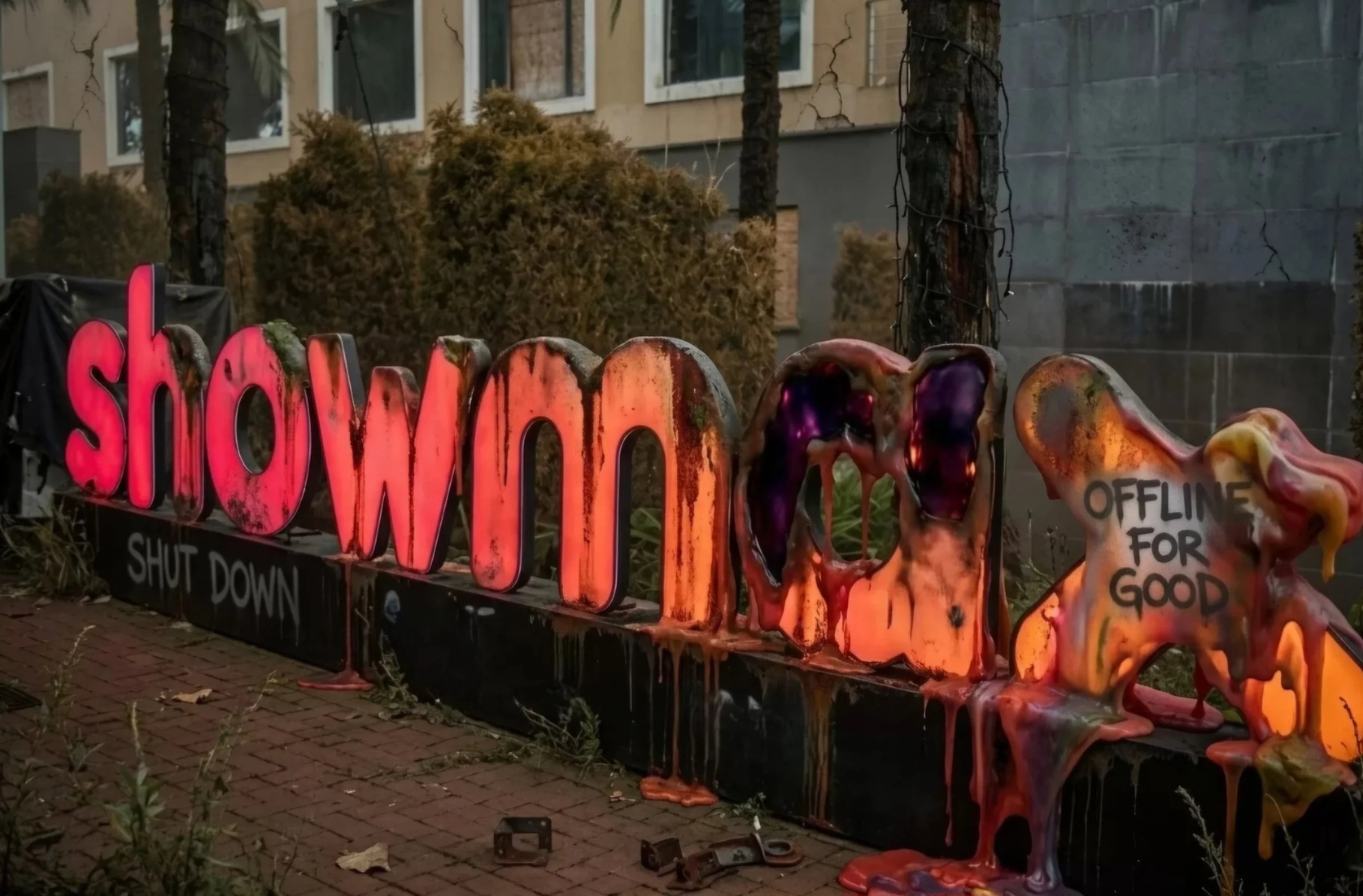
🥊🥴 March 2026 gave the creative industries some tough love.
Being a creative, an entrepreneur, or even an investor usually means being more optimistic than average. But this month made sure to remind us that things are not always as rosy as we may want them to be.
First, Showmax was killed off by Canal+. The reasons for this sad news were financial of course, but also strategic. Then the Next Narrative Africa Fund revealed its first slate, and not everyone was pleased. Spotify also released its new streaming data for Nigeria, and it was good or meh, depending on who you ask. In this edition of HUSTLE & FLOW, I talk about this gap between optics and economics.
I also go over my recent trip to Nairobi, and the overlooked opportunity that I discovered there - and that one is definitely positive.
Read on to find out! 👀👇
STREAMING
That’s it: as of March 31st, you can no longer subscribe to Showmax. And in 30 days, Africa’s only homegrown competitor to Netflix will go dark.
💸 By now, you’ve read the numbers, and they’re so bad that it’s hard to dispute Canal’s brutal verdict. Showmax was bleeding money. In its 11 years of operation, the streamer had accumulated $430 million in losses, including $268 million just last year. Another way to put it is this: for every $1 Showmax made, it lost $2.50. Ouch.
So Canal+’s logic is clear. It paid $3 billion for a group facing subscriber losses, currency devaluations, and a streaming unit hemorrhaging cash at scale. It had promised significant cost synergies to its shareholders. It had to cauterize the wound.
But there was also another reason, which Olumuyiwa Olowogboyega at Notadeepdive unpacked in a brilliant piece (read it here).
The shutdown was not a simple reaction to bad results: it was baked into Canal+'s business model from the start. We were just all (except Olumuyiwa) too distracted to see it.
Let’s unpack it.
One of the reasons Multichoice’s business was always so confusing is that it went by many different names (Multichoice, Dstv, Mnet, Showmax) and pursued different business models. For example, Dstv is a Pay TV service that aggregates various linear channels, including its own, such as Mnet and Supersport, and sells them to you as bundles. Meanwhile, Showmax was a standalone streaming service with no connection to Dstv, only giving subscribers access to content it had either acquired or licensed directly. With this model Showmax was competing frontally with Netflix.
Compare this to Canal+’s much cleaner approach: in everything it does, the French operator is primarily an aggregator. Its Pay TV offer is similar to Dstv, but its inhouse streaming service, myCanal, is not a standalone service. From its launch in 2013, myCanal was designed as a single interface through which subscribers access Canal+'s own channels and on-demand options, alongside third-party services.
🤝 Netflix got bundled into myCanal’s French subscription tiers as early as 2019. Disney+, Paramount+, Max, and Apple TV+ followed. The Netflix-Canal+ bundling agreement was then extended to 24 Francophone African countries in July 2025. Canal+ CEO Maxime Saada has described the company's relationship with Netflix as "80% partners and maybe 20% competitors."
Canal+ was never really fighting Netflix or any of the other global streamers.
And there lies the crux of the matter: as Olumuyiwa puts it, you cannot simultaneously build a Netflix competitor and bundle Netflix. The two models are simply incompatible. From the moment Canal+ set its sights on acquiring Multichoice, it knew it had to kill Showmax.
Instead, Canal+ will deploy its own myCanal and TV+ apps, already engineered for offline viewing, mobile-to-TV integration, and low-bandwidth environments, and will continue expanding its Netflix bundling partnership across anglophone sub-Saharan Africa. Makes sense.
⚠️ But what the strategic logic does not account for is what gets lost in the execution.
Showmax was a brand with high awareness and solid market share in anglophone Africa, where Canal+ doesn’t resonate. Showmax's brand equity was actually an asset Canal+ acquired then chose to destroy. A collateral damage of the deal, perhaps.
Showmax was also not just an app with broken unit economics: it had become the most serious commissioning operation focused on African content on the continent. The teams had learned, slowly and at enormous cost, what African audiences actually watch and what price points hold. That market intelligence doesn’t live in the catalog that will be migrated to Dstv Stream but in people and relationships
🧠 Canal+ has committed to no retrenchments. But the question is whether the people who built that editorial capability will still be doing editorial work or whether they will be absorbed into other teams. Kill the product if you must, but please, preserve the brain.
FILM
🎬 The other announcement that got the internet talking this month was the reveal of Next Narrative Africa Fund’s (NNAF) first slate.
Founded by former US diplomat Akunna Cook, NNAF operates as a hybrid: $10 million in development grants for scripts, combined with $40 million in commercial equity once projects are production-ready.
The nine projects selected from more than 2,000 submissions spanning 80 countries are:
a South African action film produced by Trevor Noah
a political thriller from Rapman, the British-Ghanaian director behind Netflix’s “Supacell”
an action drama starring and co-written by South African actress Thuso Mbedu
a Lagos whodunnit from the Esiri Brothers
a Cold War-era Ghanaian spy series with André Holland as executive producer
a musical-fantasy starring Banky W and Adesua Etomi
a political drama by Sudanese filmmaker Mohamed Kordofani
a comedy-horror by Zoey Martinson
and a Nigeria-based sci-fi romance by Boma Iluma.
These first nine projects have received script development support between $20,000 and $100,000 per project, not production investment. If they make it through to production, Cook estimates they would represent over $60 million in production activity on the continent.
👅 The announcement got filmmakers' tongues wagging. The dominant feeling was sharply captured by Kenyan actress and scriptwriter Serah Mwihaki, who wrote: “if a guy like Trevor is competing in the same pool, then what are my chances?”
Tambay Obenson at Akoroko LLC and the African Film Press wrote the most precise and honest analysis of the whole wahala, and I recommend reading it in full here. His core observation: the disappointment is legitimate, but it's being directed at the wrong target.
NNAF is a commercial fund with a nonprofit development arm. Cook has been clear that she is not running a charity, and that diaspora audiences expand the market in ways that support larger budgets and wider reach. A slate that reflects that logic is not a betrayal of the fund's stated mission - it is the mission.
NNAF never promised to discover and finance the next generation of filmmakers based on the continent. It set out to develop and co-finance commercially-sound African content that can travel far enough in the world to “change the narrative”. To support that strategy, it set a target production budget at between $3 and $7 million, which allows for a certain level of production quality and the participation of some relatively big names that can draw attention. This type of budget is substantial for African films, and if such a film is going to be financed by private funds, it needs to sell. Sell where? This kind of money cannot be recouped on the African continent only. Hence the diaspora angle.
The frustration, Tambay argues, comes from the gap between what the name "Next Narrative Africa Fund" seemed to promise continent-based filmmakers, their probably misplaced expectations of what such a fund can achieve, and the simple market reality.
🏗️ The harder structural point is this: when public support systems are absent, when co-production agreements are thin and national film incentives are patchy, a single private commercial fund starts to bear the weight of an entire missing architecture. It looks like more than it is. And when it then behaves like the commercial vehicle it was always designed to be, the letdown hits disproportionately hard. The problem is not NNAF, but everything that should exist around it and doesn't.
In my 2021 report for UNESCO on the African Film and Television Industry, I laid out some recommendations for countries that want to develop their film ecosystem. Five years later, most are still valid: remove administrative and fiscal barriers to film production, implement local broadcast incentives and quotas, support local stars, develop tax rebates systems, sign co-production treaties, organize (especially niche) festivals, strengthen collective management organizations and empower them to fight piracy, and more.
A private initiative like NNAF, however well intentioned, is not the right vehicle to fix market infrastructure failings. That’s the role of governments.
But emerging writers shouldn’t despair, as another opportunity to access serious development infrastructure has just landed.
🌴Former Netflix exec Funa Maduka has launched Palmtrees, a screenplay incubator to support filmmakers based in regions that have historically lacked “the infrastructure to develop them at the rigor the global market demands.”
Funa was the original African film champion at Netflix, way back in 2014 before the streamer was even available on the continent. She spent six years there leading international original films and acquisitions, and played an instrumental role in expanding the company’s content in Europe, Middle East, Asia, and Africa. She was responsible for Netflix’s first African content acquisitions, including Lionheart, for example. She also produced and directed Waiting for Hassana, the first Nigerian film to world premiere at the Sundance Film Festival.
So, she’s not a newcomer.
⚡For Palmtrees, Funa partnered with Neon, the indie studio behind Parasite and Anora and arguably the most credible champion of world cinema working in the US market today.
The program will select 8 to 10 writers from Africa, the Middle East, Latin America, South Asia, Southeast Asia, the Caribbean, and Oceania. Selected writers receive one-on-one script development support, compensation throughout the process, and a three-week in-person residency. Applications are open now, with a June 1 deadline.
You won’t be competing with Trevor on that one.
MUSIC
Spotify’s annual Loud & Clear report landed on March 16 with the usual fanfare.
📈 In it we learned that Nigerian artists generated ₦60 billion (about $43.4 million) in revenue in 2025, a 140% increase over two years. Total streams hit 30.3 billion, local consumption surged 170% year-on-year, and independent artists captured 58% of all royalties. A good story.
Then Tochi Louis at Creator Economy IQ did the real work (download his comprehensive Music Business 2025 report here), and the picture got considerably more complicated.
The consumption figures are genuinely impressive. Nigeria generated 3.77 billion Spotify streams in 2025, up 53% from 2.46 billion in 2024, confirming it as the largest streaming market in Africa by volume.
Even more striking, 92.12% of those streams went to Nigerian artists, making it one of the most locally concentrated streaming markets on the planet. Nigerian listeners are proud of and loyal to their music. When they do stream foreign music, the appetite is remarkably narrow: nearly 42% of all streams directed at US artists in Nigeria in 2025 were generated by a single act, the rapper Gunna (who knew? 🤷🏽♀️).
In contrast, Spotify streams in South Africa actually declined 3.7% in 2025, from 1.94 billion to 1.87 billion - possibly a sign of a maturing market. South African listeners are more internationally curious, with foreign consumption spread across multiple artists.
But here is where the economics undermine the optics. Despite Nigeria’s consumption boom, the real dollar value of its streaming revenue has been eroded by approximately 44% since 2023, driven by the devaluation of the naira.
💀 Also, Spotify doesn’t pay a fixed rate per stream. It distributes royalties proportional to each market’s subscription revenue pool. A Nigerian Spotify Premium subscription costs around ₦1,600 per month (~$1.17), while the US equivalent runs to $13.78. So, as local streams grow, the per-stream payout shrinks, because the pool is funded by one of the cheapest subscription tiers in the world, in a currency that has halved. Kenya, by contrast, saw the real value of its streaming revenue increase by about 18% over the same period. South Africa experienced a more moderate decline of around 8.5%. So the naija curse struck again: Nigeria is doing the volume but its economics are actively sabotaging it.
Tochi also studies the Nigerian music ownership structure all the way to the top. His analysis reveals that, while Nigeria’s music ecosystem looks diverse at the label level, just three companies control over 70% of Nigeria’s total streaming volume once you follow the money to the distributor and parent-company level: Empire, Sony, and Universal Music Group. Which means that the companies that negotiate with DSPs, control metadata, and hold the licensing relationships are, with very few exceptions, foreign.
As competition for control over Africa’s music export infrastructure intensifies, the number of streams Nigerian artists are generating is just one data point. More impactful for artists on the ground is how much revenue is generated, where and how, where value leaks, who controls distribution, and who ultimately captures the royalty flow.
DIGITAL INFRASTRUCTURE
Another March announcement was for the upcoming launch of Communiqué OS, the new digital platform of creative economy intelligence company Communiqué.
What is it? Well, I’m waiting for the platform to go live to experience it for myself, but here’s what we know so far:
📊 Communiqué calls it “a Bloomberg terminal” for the creative economy. The platform indexes Africa’s creative economy across 54 markets, 1,068 verified entities, and $4.2 billion in tracked capital. It offers a Creative Economy Health Index that scores countries on investment attractiveness. Embedded within is a cool new tool that Communiqué debuted in their latest Creator Economy report: the Audience Anchor Ratio (AAR). It measures export-readiness through the percentage of a creative entity’s audience that is based outside its home country (Nigeria scores high there, of course).
The platform also includes a Creators Hub with various resources for creative professionals. Later, Communiqué also plans to release a matchmaking engine that surfaces data-informed connections between founders, investors, and operators.
💰 Discovery is free but intelligence is not. The business model is token-based, which basically means that you buy a package (starting at $8) to access a certain amount of premium analysis for an unlimited time period.
Communiqué’s founder David Adeleke has been building the knowledge infrastructure for this industry for years. Now he’s turning it into a product. Will you use it? Let me know your thoughts.
SPECIAL KENYA FOCUS: NOTES FROM NAIROBI
✈️ 🇰🇪 A few weeks ago I spent more time in Nairobi than my usual dash in-and-out.
I wanted to take the time to talk with people and see if there was any opportunity in the Kenyan creative space that I had missed.
Turns out there was.
First, let me start with the more obvious. West Africa is particularly strong in music, film, fashion and visual arts. Kenya…not so much. Obviously, there are exceptions and brilliant Kenyan artists in all these disciplines. But overall, those are not sectors where Kenya particularly shines, for reasons that have to do with culture and costs, not talent or skill.
Kenya, however, distinguishes itself in other ways.
🖥️ First, CreaTech. Kenya’s tech space is strong, organized, and forward-thinking. I always say that Kenya is a country of early adopters. These positive characteristics have started transferring to the CreaTech sector, where we have seen startups like HustleSasa, Wowzi and Twiva raise money and develop real businesses. And there’s more coming.
🎤 Second, live entertainment. Nairobi is one of the most active cultural cities on the continent, and the live entertainment sector reflects that. Crucially, it’s also much more structured and easier to navigate than Lagos or Accra. Festivals like Blankets & Wine and SolFest have long stopped being simple events to become cultural IP, recurring brands with real audience loyalty and monetization potential. Companies like HustleSasa and MOOKH AFRICA handle discovery, ticketing, audience data, promoter financing and even, for HustleSasa with its ANZA MMA and Friday Fight Nights, original IP creation.
🪑Third, homeware. If Kenya’s path to scale in fashion is hard to pinpoint (besides the huge success of Vivo Fashion Group), the country’s homeware and lifestyle design sector is better positioned. It benefits from a deep craft base in woodwork, ceramics, weaving, and metalwork, a growing design sensibility aligned with global tastes, and a strong domestic anchor in tourism and hospitality. High-end lodges, boutique hotels, and restaurants are increasingly sourcing locally designed furniture and décor, creating a production base that does not depend on export markets from day one.
But here’s what had previously escaped my radar: Kenya’s food scene is POPPING. 🍽️🍽️🍽️
Kenyans spend almost 50% of their income on food on average (more in rural areas, less in urban centers), one of the highest rates globally. Kenya also has a particularly diverse agricultural output, making it a top global exporter of tea, coffee, fruits and vegetables.
These drivers, plus the high proportion of foreigners in the country, have turned Nairobi into fertile ground for a recent boom in new restaurant concepts, from Cultiva, to Hero Bar, The Diner or Beit es Selam.
Several of those have the potential to become specialty dining chains. The OGs in that space are Java House, which launched in 1999, and Artcaffé, founded in 2008. Java began as a single café in 1999, scaled into a regional platform across East Africa with 100 locations, attracted private equity, and was eventually acquired by institutional investors. Artcaffé, with 60+ outlets and a deliberate blurring of the line between restaurant, bakery, retail and even gourmet concept store with Artcaffé Market, took the model further. Both chains diversified their portfolio to include other restaurant brands and retail food products.
💡 These case studies show that a Kenyan food concept can achieve the level of operational standardization, brand consistency, and revenue predictability required to be treated as a real asset class.
But restaurants are only one layer, and arguably not the most interesting one from an investor perspective, because their forex potential is limited unless they expand regionally.
📦 The more compelling opportunity is in premium packaged food and beverage brands, where Kenya has a credible path to export-led growth.
☕ Tea and coffee are the clearest and oldest examples. Kenya is one of the world’s largest tea and coffee exporters, but historically most of that value left the country unbranded. This is changing now with brands like Kericho Gold, Over a Drink, or Spring Valley Coffee.
Then there are the smaller but structurally interesting plays. As someone whose only vice is dark chocolate, I was excited to discover that Kenya now had sprouted high quality bean-to-bar brands like The Chocolate Bar, with beans sourced from Uganda. I came back with a large supply in my luggage, which has since then been decimated. Ghana and Cote d’Ivoire, watch out.
🌿And then there are businesses like Cocopure, which is building a portfolio of superfood powders targeting the global wellness market.
What ties these together is a shift from upstream commodity supplier to downstream brand owner. Kenya’s historical role in global food systems has been production. The current transition is toward branding and packaging (which I was surprised to find were top-notch, especially compared to similar products in West Africa), and direct consumer relationships. That’s where the margin sits. 💰
This just gave me one more reason to start planning my next trip to Nairobi.