
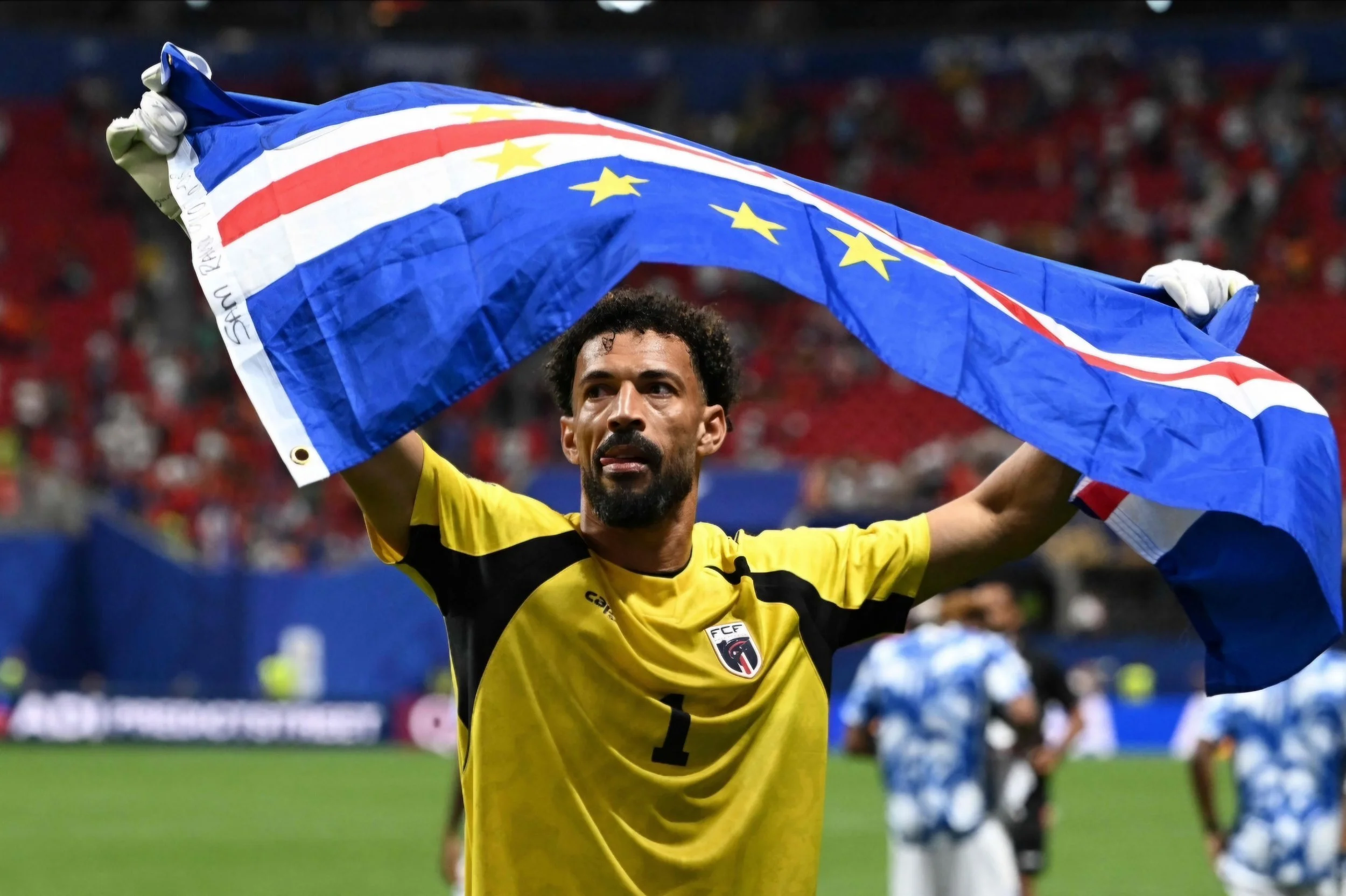
🏆 Every World Cup crowns two champions: the one who wins the trophy, and the one who wins the world's heart.
🇨🇻 In 2026, the second title has already gone to Cabo Verde, the tiny West African island country of barely half a million people - the 3rd smallest country to qualify for the World Cup, after Iceland and Curacao.
From the very first moment, their accomplishments delighted viewers: first World Cup participation, three draws with Spain, Uruguay and Saudi Arabia that turned them into the smallest nation to ever reach the knockout stage.
And then a beautiful game against defending champion Argentina in which they equalized twice and almost won.
🏃🏽 The face of the run was 40-year-old goalkeeper Vozinha. His Instagram following exploded from 46,000 to over 27 million, making him the most-followed goalkeeper on the planet.
Before the tournament, most people didn’t even know Cabo Verde existed. Thanks to its talented, wholesome, and even heroic participation in the biggest event in the world, the country has now won dozens of millions of fans… ready to be converted into visitors.
This is the perfect opportunity for us to take a look at what’s been happening over there.
🏝 Tourism already represents about a quarter of Cabo Verde's GDP, with 1.18 million arrivals in 2024, or more than twice the population.
But for now, over 70% of visitors come from just seven European countries, 80% of hotel nights are concentrated on two of the nine inhabited islands, and the dominant all-inclusive packages keep spending locked inside foreign-operated resorts. The average visitor spends only €41 per day, compared to €238 in the Canary Islands.
🚀 The World Cup has produced a measurable demand shock: Expedia recorded an 800%+ surge in searches from US travelers, a market that today represents just 1% of Cabo Verde's hotel guests despite a massive Cabo Verdean-American diaspora in New England.
The government is racing to convert that attention before it fades. It even ran investor events around the team's matches in the US.
And this is not the only smart thing that this government has been doing, tucked away in their little corner of the West African coast.
Being based in Lisbon, I hear about Cabo Verde a lot (although I haven’t been there yet, an oversight I’m looking to correct asap), thanks to their omnipresent diaspora, but also because they’ve been sending a strong delegation to the Web Summit for several years.
Indeed, the country has spent years methodically building the most coherent tourism-culture-digital strategy of any African state, except perhaps Rwanda.
Just over the past 14 months:
💻 Cabo Verde actively pursued its goal to become a regional tech hub attracting local and foreign talents, with the ambition of growing its digital economy to 25% of GDP by 2030.
In May 2025, the country inaugurated TechPark CV, a €45.6 million AfDB-funded technology park with campuses, a data center, and a Special Economic Zone status offering a 2.5% corporate tax rate. A Startup Act is in the drafting stages with World Bank support.
📀 In April this year, the Kriol Jazz Festival celebrated its 15th edition in Praia, back-to-back with the 11th Atlantic Music Expo, a deliberate clustering meant to boost the tourism-culture-creative industries connection.
The goal of the Ministry of Culture and Creative Industries (they have one!!) is to turn the capital into a transatlantic music marketplace each year, timed precisely to the rise of tourism season.
🏛 Also in April, Cabo Verde was designated African Capital of Culture 2028, with the selection committee specifically citing the strength of its cultural policies and investment mechanisms.
Notably, the government has moved culture and the creative industries from the social pillar to the economic pillar of the national budget.
All of this had been going on in the background, way before the Blue Sharks put their country on the world stage. Looks like Cabo Verde is ready to seize its moment.
I, for one, am planning my trip. Do I have any readers from there? Let me know.
DIASPORA: A TALE OF TWO CITIES
💂🗼Last month I spent time in both London and Paris on a mini African diaspora European tour.
In Creative Cash Flow, I write a lot about the market opportunity that the African diaspora represents for African creative enterprises.
So I took the opportunity of this trip to investigate the strengths and weaknesses of these two hubs.
📊 First, a complication: you can count London, but you can only estimate Paris.
The UK census records 1.5 million Black Africans in England and Wales, with nearly half of the country's African population living in Greater London.
We even know the exact detail: 271,000 Nigerians, 150,000 Somalis, 113,000 Ghanaians, 53,000 South Africans, etc.
France, by contrast, is constitutionally barred from collecting ethnic statistics. So we only know that 3.5 million African-born immigrants live in the country (including North Africans), mostly in the Paris region.
The diaspora there is almost certainly larger than London's, but we don’t know who they are exactly - although empirically we can observe large populations of Algerians, Moroccans, Tunisians, Malians, Senegalese, Ivorians, Guineans, and Congolese.
📖 In London, I launched Creative Cash Flow at the Communiqué IRL event, in front of a room of sharp and connected diaspora entrepreneurs, who maintain a close connection to the continent through regular visits. The London diaspora is clearly entrepreneurial, motivated, and ready to spend on African cultural products.
🎨 African art programming in London is also world-class. In my short time there, I managed to catch a talk by photographer Derrick Boateng, a gallery show by Yinka Ilori, and the Project a Black Planet exhibition at the Barbican.
London's institutions are waking up to the Africa opportunity. Sadiq Khan led a trade mission to Lagos, Accra, Johannesburg and Cape Town in July 2025, with 27 London companies in tow, and recently hosted a reception celebrating Lagos and London as twin creative powerhouses.
But then, despite all of this, London still lacks proper places where Africans can gather, celebrate their cultures, do business, and build community. To be fair, there is The Africa Centre, which unfortunately I didn’t have time to visit.
I did stop by TALES House, London's first African concept store of its kind. A welcome initiative, but how could this be the first such store in a city with over a million Black residents (including the Caribbean) and the deepest pool of African diaspora wealth in Europe?
🍽 London does have one vertical where execution excells: food. The city now counts three Michelin-starred West African restaurants (Ikoyi, Akoko and Chishuru). Chuku’s is a classic, and this time I also tried Akara, which didn’t disappoint. Few things in the world make me as happy as neo-West African cuisine.
🔎 Meanwhile, in Paris, the feeling was different. Less money perhaps, but more intent. In fact, The Guardian's just published an article exploring Paris as a nexus of Black culture.
I visited the Little Africa Village concept store, beautiful and impeccably curated (if you’re in Paris, head over there to find copies of Creative Cash Flow!), and the great AFRICA NOW pop-up at Galeries Lafayette.
There is also MansA, the state-backed Maison des Mondes Africains, which runs a super active cultural program and a creative-industries incubator in a 800m² space, and Union de la Jeunesse Internationale, which runs 6,000m² of exhibitions, workshops and fashion retail in the former Tati Barbès building. Paris also has its own Michelin-starred culinary wunderkind Mory Sacko.
The difference between the two capitals is political. France does not have a good reputation across its former colonies - that we know. So financing African culture has taken an increasingly strong strategic importance. Soft power is how Paris is attempting to rebuild its African relationships. Britain has always had a more straightforward, business-focused approach.
My interest is not in never-ending political debates, but always on what can be leveraged to boost the African creative economy.
💡So my conclusion is this: both cities are primed and ready to showcase and sell African creativity. The entry points, and the gaps to fill, are different.
FASHION
👜 Still on the topic of African creative products and diaspora markets, IFC formally announced last month the first cohort of its African SME Fashion Champions program, which I had the opportunity to advise on in its early stages.
📈 Focused on established Fashion SMEs with substantial revenue (over $1M/year), high growth potential, and meaningful export sales, the program includes custom technical assistance to prepare each company for investment, guidance through various financing options, and connections with global markets.
IFC mapped 650 companies across 10 countries and identified 35 for its first cohort.
In Paris, four of those - Christie Brown (Ghana), Rich Mnisi (South Africa), Algueye Dakar (Senegal) and Mai Atafo (Nigeria) - were able to participate in an immersion program at Station F in partnership with HEC business school.
I can already hear fashion designers say that these criteria exclude 99.9% of African fashion businesses.
Yes, and that’s the point - the goal here is truly to identify the champions with the most potential to become global businesses. We need those oo.
FILM
🎬 While the rest of the industry debates how to survive, Nigerian filmmaker C.J. "Fiery" Obasi is on fire. “It’s in the name”, he told me.
Already well known for winning the Sundance 2023 Special Jury Prize with his film Mami Wata, CJ just announced his next feature: The Boy Who Runs, a biopic based on the life of Ugandan athlete Julius Achon.
The story traces Achon's path from northern Uganda, where he was abducted as a child by the Lord's Resistance Army, to NCAA champion at George Mason University, the elite Nike running world in Oregon, and eventually a seat in Uganda's Parliament. That certainly does sound like a movie.
But that’s only the FOURTH project that CJ is involved in at the moment.
There’s also:
🔺 La Pyramide, a Nigeria-UK-US-Senegal-Brazil co-production, now in post. On this film, rather than endure the long development and funding cycle that preceded Mami Wata, his team started shooting to show the vision. "Now, folks can see it's a moving train. You can either hop on or watch it fly past you," said CJ.
🦋 A Blue Butterfly, a psychological drama starring Sanaa Lathan, which has completed filming in London and moved to Rwanda for a further shoot, backed by UK production company Boudica Entertainment.
🇰🇷 And in May, CJ was named the inaugural fellow of a new African-Korean filmmaker residency launched by Seoul-based production company Flix Oven in partnership with Continental Entertainment. He will spend a month in Seoul developing a feature bridging African and Korean cultures, destined for theatrical release - with Morgan Freeman attached as executive producer, no less.
CJ’s high-speed train has indeed left the station 🚂
ANIMATION
Another great news in the African content space:
🇪🇹 Ethiopia’s Behagerlij Studio won both the Disney Television Animation Prize AND the AGrAF Prize for its animated preschool series Sunday Morning at the prestigious Annecy International Animation Festival (the Cannes film festival for animation).
🎉 I’m particularly happy for them because I had the chance to see the team pitch their project (and win) last May in Addis at the Ethio-French Creative Forum, and it was immediately clear to all of us present that it was very special.
With Sunday Morning, Behagerlij managed to hit the holy grail of storytelling: a deeply-rooted story that tells a universal truth. The series is about four kids getting into all sorts of shenanigans while trying not to wake up their mother who’s just desperate to sleep in on a Sunday morning.
🤞 Besides the $10,000 check that comes with the Disney prize, Behagerlij also secures a development deal for Sunday Morning with Disney, possibly leading to a future Disney Channel or Disney+ series.
For more on the journey of Behagerlij's team from meeting under bridges to shining on animation’s brightest stage, read this nice write-up in Maurice Chapot’s newsletter.
STREAMING
Continuing with the positive content news this month:
Netflix’s still got it, you guys.
“The Polygamist” is a global hit.
The South African drama, adapted from Zimbabwean author Sue Nyathi's novel and produced by Stained Glass TV with Akin Omotoso as showrunner, dropped all 22 episodes on June 12.
🚀 Within its first week it reached No. 2 globally and No. 1 in 16 countries. By the end of its second week it ranked in the top 10 in 63 countries, including the United States and France.
If you haven’t watched it already, at least you can guess from the title: the story is juicy.
👴🏾 👰🏽👸🏽 🤰🏾💃🏽 A wealthy banking tycoon, a proud wife, a hidden second spouse, an ambitious mistress, and a glamorous young girlfriend. The show has everything: wealth, betrayal, female revenge, cultural realities that are yet also taboo. In a way, that’s the Zulu version of Senegal’s mega hit “Mistress of a Married Man”.
The story behind the story may be even more fascinating.
First, the novel spent a decade being rejected by mainstream publishers before Sue Nyathi eventually self-published it, enabling the book to find its audience.
Then, the team behind the project lived and breathed the story, to say the least.
😯 Two of the show’s producers, Gugu Zuma-Ncube and Thuli Zuma, are the daughters of former president and notorious polygamist Jacob Zuma. Another sibling, Nkosazana Zuma-Mncube, is also credited as a writer. Thuli explicitly said that a number of scenes were drawn directly from their family's own experiences.
Looks like Africa has the juicy soap genre locked down. That’s a win I guess?
Moving on to the infrastructure side of the streaming business.
Earlier this year, I wrote a series of posts about streaming in Africa, and I called the telcos’ performance so far… honestly embarrassing 😳
If you missed the series, this is what I said:
⛓️💥Attempting to build an independent African streaming platform is structurally doomed, because the ARPUs are too low, the costs too high, and the path to scale in a fragmented continent too long and too complex.
If we look at what worked in other emerging markets - Globoplay in Brazil, Vidio in Indonesia, TrueID in Thailand - the formula becomes clear.
In each case, the winning streamer was the offspring of a telco or incumbent broadcaster parent with deep pockets, a catalogue of desirable content, pre-existing distribution, and strategic reasons to absorb the losses.
In Africa, this should have been the telcos.
🃏 African telcos are the true overlords of African consumer businesses. They hold all the cards: the distribution scale, the customer relationships, and the billing infrastructure.
🚰 And yet, so far none of them have managed to build a proper video service, mainly because building the pipes and mixing the juice (the content), are two very different jobs.
Enter MTN One TV.
This is not MTN’s first attempt in this area. In 2014, it had launched FrontRow, which was rebranded as VU, and was dead by 2017. The content didn’t gel.
But they are in a strong position, and there are a couple new positive signals:
🔹 MTN has 307 million subscribers across 16 African markets, a customer base literally no one else (including Canal+Multichoice) can approximate
🔹 Payment via airtime and mobile money removes the single biggest barrier to streaming adoption on the continent
🔹MTN One TV will offer a mix of free-to-view, advertising-supported, pay-per-view, and subscription-based content models depending on local market conditions (hybrid monetization is the way to go)
🔹 The timing is fortunate. Showmax left a real gap in the streaming landscape when it shut down in April
🔹 MTN has been quietly investing in and building a library of original content for at least two years now - although content producers in-the-know are telling me, “meh”
The future of MTN One TV is likely to hinge on that last point.
The industry collectively better understands what African audiences want today than it did 10 years ago, thanks to the experiments conducted by Netflix, Amazon and Showmax.
⚠️ However, the ground has already shifted underneath our feet. The real competitors are now YouTube, TikTok, and the micro-drama platforms.
In fact, as one of my readers pointed out, a smarter approach would have been for them to START with micro-dramas, and possibly expand later.
And guess what? Yes another player has entered the game, with exactly this strategy.
That new player is Lebara Nigeria.
It just launched LebaraPlay, presented as “Africa's first telecoms-owned micro-drama platform”.
📱 Lebara is a low-cost UK-based MVNO (Mobile Virtual Network Operator) founded in 2001, which targets frequent travelers and immigrant communities and operates across Europe as well as Saudi Arabia and Australia.
In Nigeria, it is a recent entrant. Into a market dominated by MTN and Airtel, LebaraPlay is clearly part of a differentiation strategy: using content to acquire and retain customers in a brutally competitive space.
🚀 The micro-drama format (high-addictive episodes of 30 seconds to three minutes, shot vertically, monetized through ads and micro pay-per-view) has suddenly become the fastest-growing segments in global entertainment.
While leading companies like ReelShort and Dramabox both originated in China, the model has found success worldwide.
🤯 In-app revenue for micro-drama content reached $3.8 billion in 2025 and is forecast to more than double to $30 billion in 2030. ReelShort attracts an average of 35.7 minutes of daily viewing per user, outperforming Netflix, Amazon Prime Video, and Disney+.
The format itself has already been landing on the continent: ReelShort and DramaBox have African users, South African production company Both Worlds began producing micro-series in isiXhosa and isiZulu in late 2025, and in Nigeria, Storyformat Studios is attacking the opportunity from the training angle.
Lebara's approach is to bundle content with connectivity, using micro-drama as a customer acquisition and retention tool for a telco brand. Telco billing integration could be a game-changer, if LebaraPlay can wire that together.
The debut title is “Imported Bahu”, a Nollywood-Bollywood crossover romantic series produced by Forever 7 Entertainment (the team behind “Namaste Wahala”). The Nigerian rollout begins in July.
This is smart, but it’s also a strategy that will only work with a high volume of content.
Lebara will have to go big or go home.
MUSIC
🎧 I’ve often said that, of all the sectors in Africa's creative economy, music is where the gap between cultural impact and local value capture is most glaring.
A new study now puts a number on this phenomenon.
💸 According to the Music Economy Development Initiative (MEDI), a partnership between the Center for Music Ecosystems and Global Citizen, $286 million in recorded music revenue is estimated to go uncollected in Nigeria and Kenya alone.
In 2025, Sub-Saharan Africa's recorded music revenues hit $120 million according to IFPI. Every year, this number is celebrated as a milestone, when in fact it is minuscule relative to the continent's population, consumption levels, and cultural output.
The MEDI study shows clearly what is the size of that gap for Nigeria and Kenya.
MEDI has also built a data portal covering all 55 African countries, the first platform to provide continent-wide music ecosystem data of this kind.
As we know, the plumbing is the problem: broken copyright collection, weak metadata infrastructure, fragmented CMOs, and foreign control of the distribution layer. All of this leads to value being generated on the continent actually being captured elsewhere.
📊 Data won't fix broken CMOs. But you can't fix what you can't measure, and for too long, African music's infrastructure gap has been argued from anecdote rather than evidence.
Worth noting is that a small but growing number of startups are trying to change this (including Makerverse, Royalti.io and AfroSoundtrack), tackling rights registration, royalty collection, metadata, and publishing administration for African creators.
WHAT’S UP AI
Remember when I wrote that Google should give free access to its AI tools to African creators, in the same way that it gave free access to African students?
Well, they heard me. Jkjkjkjkjk. They heard Idris.
🤖 Google and Idris Elba just announced a $1 million initiative to give roughly 100,000 African creators access to Gemini and other AI tools across Nigeria, South Africa, Ghana, Kenya and Sierra Leone.
Google's SVP James Manyika framed it as solving a structural problem: creatives who don't have "enormous studio budgets" will now be getting a shot at AI-powered production tools. Yup, that was the idea.
🏃🏿 I do not know how they will pick the 100,000 lucky ones, but get on it people! Knock at the door of your local Google office and make your case.